
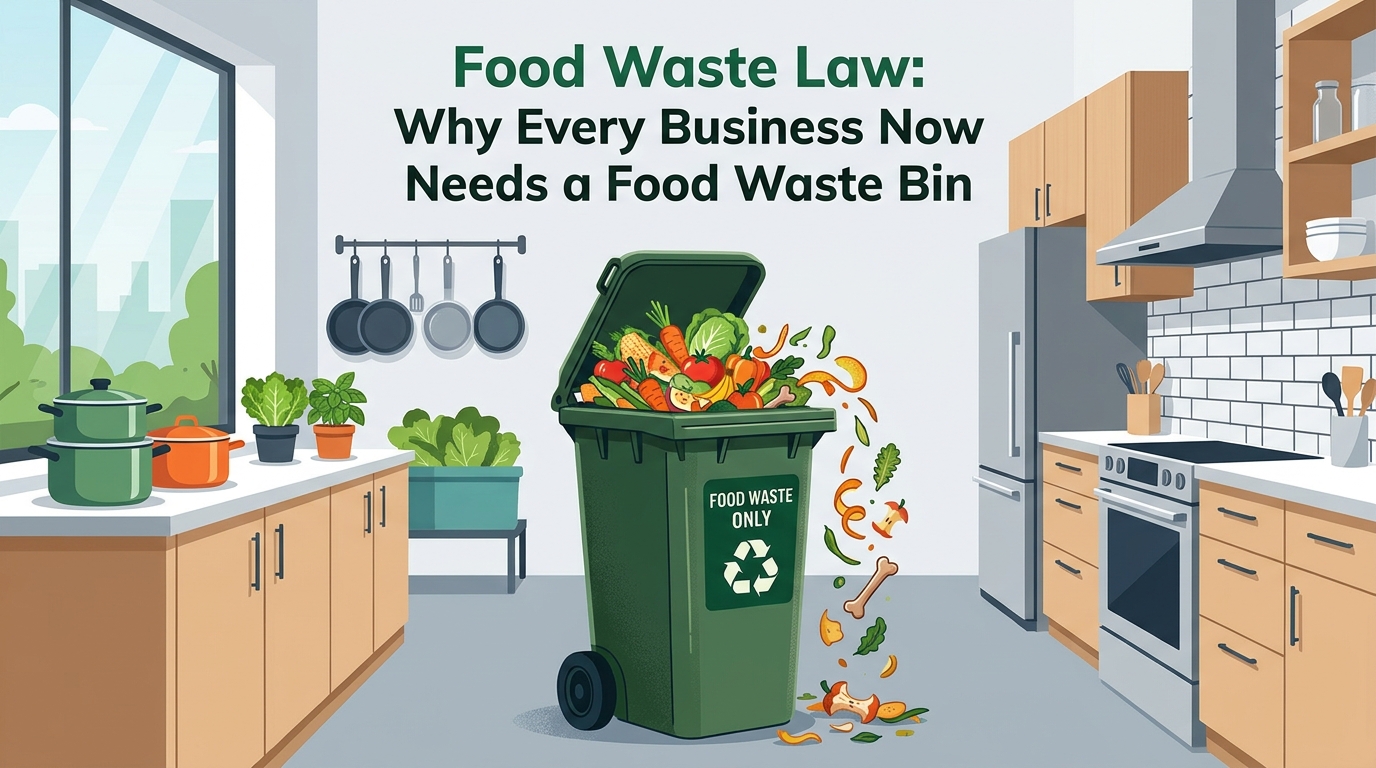
The rules on business waste in England have changed. Under the government’s Simpler Recycling law, every workplace has to keep food waste separate from general rubbish before it is collected.
Larger businesses have had to do this since 31 March 2025. From 31 March 2027 the smallest businesses join them too. Put simply, if you run a business in England, you need a food waste bin. Here is what the law says, who it covers and how to get sorted.
⚖️ Don’t get caught out
Micro-businesses with fewer than 10 staff must be separating food waste by 31 March 2027. Everyone else should already be doing it.
What is the food waste law?
Simpler Recycling is the workplace recycling rules for England, brought in under the Environment Act 2021. It applies to businesses, charities, schools, care homes and other non-household premises. Every workplace must split its waste into three streams before collection:
♻️
Dry recycling
Paper, card, plastic, glass and metal
🍎
Food waste
Needs its own bin and its own collection
🗑️
General waste
Anything that can’t be recycled
Food waste cannot go in the general waste bin any more.
The key dates
Already in force
31 March 2025
Businesses with 10 or more full-time equivalent employees.
Coming up
31 March 2027
Micro-businesses with fewer than 10 full-time equivalent employees.
One thing that catches people out: the staff count is for your whole business, not each site. If you run three cafés with four staff in each, that is twelve people. You were already meant to be separating food waste in 2025.
“But we don’t serve food”
This is the most common question we get. The answer is that it does not matter. Government guidance says food waste must be collected even if your workplace does not serve food or have a kitchen. There is no minimum amount either.
All of these count as food waste:
Food thrown away by customers and visitors counts too. The guidance also says staff should not be asked to take their food waste home to get around the rules.
“If anyone eats or drinks at your workplace, you produce food waste. That means you need a food waste bin.”
Which businesses need a food waste bin?
In short, almost all of them. That includes:
What happens if you don’t comply?
The rules are enforced by the Environment Agency. Businesses that ignore them risk enforcement action. Your food waste must also be collected by a registered waste carrier. If you hand it to someone who is not registered, you can be held responsible for where it ends up.
How to get compliant in five steps
Check your headcount
Add up full-time equivalent staff across your whole business to see which deadline applies.
Put a food caddy where food is eaten
Kitchens, staff rooms and any customer seating areas.
Book a separate food waste collection
Use a registered waste carrier. Check their licence number.
Tell your team what goes in it
A simple sign above the bin works wonders.
Keep your paperwork
Hold on to your waste transfer notes in case you are ever asked.
How Hartes can help
Hartes provides weekly commercial food waste collections across London, Essex and Hertfordshire. We supply the bins, collect on a regular schedule and give you the paperwork you need to show you are compliant.
£42.25
a month for weekly food waste collection
£9.75
per lift, cheaper than Biffa and First Mile
✓ Licensed
Environment Agency waste carrier CBDU617131
Get your food waste bin sorted
Don’t wait for the deadline. We’ll set you up compliant from day one.
This article is general guidance based on the government’s Simpler Recycling rules for workplaces in England. For full details see GOV.UK: Simpler Recycling, workplace recycling in England.